How much time have you spent concentrating on subjects such as identifying and recruiting new candidates? Probably a great deal. Now ask yourself this. How much time have you spent thinking about and learning advanced level closing principles and techniques? Much less, right?
This isn’t your fault. There is a serious deficiency of the knowledge of how to close in our industry. And along with that, there are serious misunderstandings. These will cause any recruiter – no matter how experienced – to lose a significant number of fees that should be yours. Why? Because the facts are that you are not paid for recruiting candidates; you are paid to get the best candidates to accept the offer! And that means closing.
Let’s take a moment and address some of the things you’ll hear when the subject is brought up.
“If you do everything right up front, the close becomes automatic.”
This is a common phrase which we have all heard. Because we hear it so often, we tend to believe it without thinking. But is it true? Not really. Sometimes a wonderful hypothesis is destroyed by some ugly facts. Here they are.
First, doing everything “right up front” on a consistent basis is a near impossibility. It presumes that first, you know exactly what’s right and how to do it and secondly, that you can implement it every time.
A good analogy would be to assume that if a baseball pitcher had control of every pitch, he would throw a perfect game. In theory, that’s true. In practice, we all know it isn’t.
This is an amazingly complex business. Some years ago, an industry trainer– Phil Ross – developed an audio series called The 27 Steps of the Placement Process. Regardless of whether there are the number of steps Mr. Ross claimed, the point is that there are a lot of them. A single mistake can cost you the fee; the same mistake made over and over will cost you many fees. Most of us will admit that we are not perfect. If that’s you, you can assume that the sweet sounding “doing everything right up front” breaks down in reality.
“If you build in a series of trial closes along the way, you won’t have to close.”
This is another statement we have all heard, but which breaks down in practice. Most people acknowledge that we are in a sales field. Yet, believing that, they do not pay attention to a foundational truth of selling – that decisions are hard, and that indecision at the close is to be expected. This was addressed by one of the great sales trainers in his field, John Lawhon, in his book The Selling Bible.
“The longer you are in sales, the more you will become convinced that a few moments before the customer says yes, a mild form of insanity takes over. Usually this final resistance is voiced as an unreasonable objection or simply an unwillingness to proceed.”
Mr. Lawhon’s background was in furniture sales, but you’ll see the same thing from sales trainers with a background in real estate, insurance, or any other field. Do they teach trial or “minor point” closes? Of course. But that alone is not enough. Nor will it be enough for you. At the end, it takes more. It takes serious closing skills.
“I get 75% of my offers accepted. No matter what I do, that’s what I get.”
Some recruiters simply give up on the concept of improvement, and adjust to the fact that they can only achieve a certain offer-to-acceptance ratio. Unfortunately, that adjustment prevents them from learning additional specific techniques or strategies which would yield increased production.
Equally to the point, a client whose offer is declined is unlikely to become a repeat client. He too is frustrated – and the recruiter is likely to be blamed. Repeat clients are developed not just by submitting candidates, but by acceptance of the offer. Our worth to the client is not solely at the beginning; let’s face it, there are other ways the client can find candidates. Rather, our worth is at the end – assisting the client in getting the offer accepted. Those who do not continue to improve their skills in this area are paying a high price in not just short-term production but in repeat clients.
“I never lose one. I haven’t had a turndown in years.”
Let’s put aside the possibility that people who say this are either fibbing or have unconsciously suppressed the memory of candidate turndowns. The latter, by the way, is understandable; who likes to dwell on a painful negative? But let’s presume this is true.
Oliver Wendell Holmes, one of our great Supreme Court justices, once observed that ”a moment’s insight can sometimes supersede decades of experience.” Here’s an insight that you ought to consider.
When you hear someone say “I haven’t had a turndown in years,” it is frequently an indication that they are not as good at follow-up after first interview as they should be. What they are doing is the equivalent of standing in the batter’s box in baseball and only trying to hit home runs.
You are not there just to hit home runs! You are there to score runs! And that means getting men on base. It means, presuming there is interest on the part of the client, motivating a not-thoroughly-convinced candidate to go out on a second interview. Doing so will not always result in a home run. But it will result in far more runs scored. That means – in our business – far more fees.
There is an easy way to measure this. Compare your sendout-to-placement-ratio with your second-interview-to-placement ratio. You will see that the latter will be at least twice that of the former. By moving the candidate to a second interview, you will double the chances of an offer and an acceptance.
Those who claim they ”never lose one” are in fact losing out on many fees that should be theirs. Concentrating on improved debriefing will lead to many more second interviews and offers, This will in turn result in greatly increased production when closing skills are added to the mix.
The Cost of Closing
Many think of closing as a single call, and presume that increased results are limited to that individual call. But in fact, everything that happens up to that point will also be far more productive.
For example, presume that a recruiter gets two offers per month. He actually has two full weeks of effort invested in every closing call. Two weeks of doing everything leading up to that moment are now on the line. One offer a month means four weeks of effort invested. Improving closing skills improves the results of everything he has done for that entire time.
Our Worth To The Client
Accept reality. In today’s market, there are other ways of obtaining candidates other than through you. We all know them. So what do we offer the client that cannot be provided through those alternative options?
Acceptances! Our primary worth to the client is not at the beginning; rather, it is at the end. Through proper debriefing and closing skills, we can help to secure the talents of the candidates he needs. But that means separating ourselves from these false understandings and concentrating on what no one else can do – debriefing and closing.
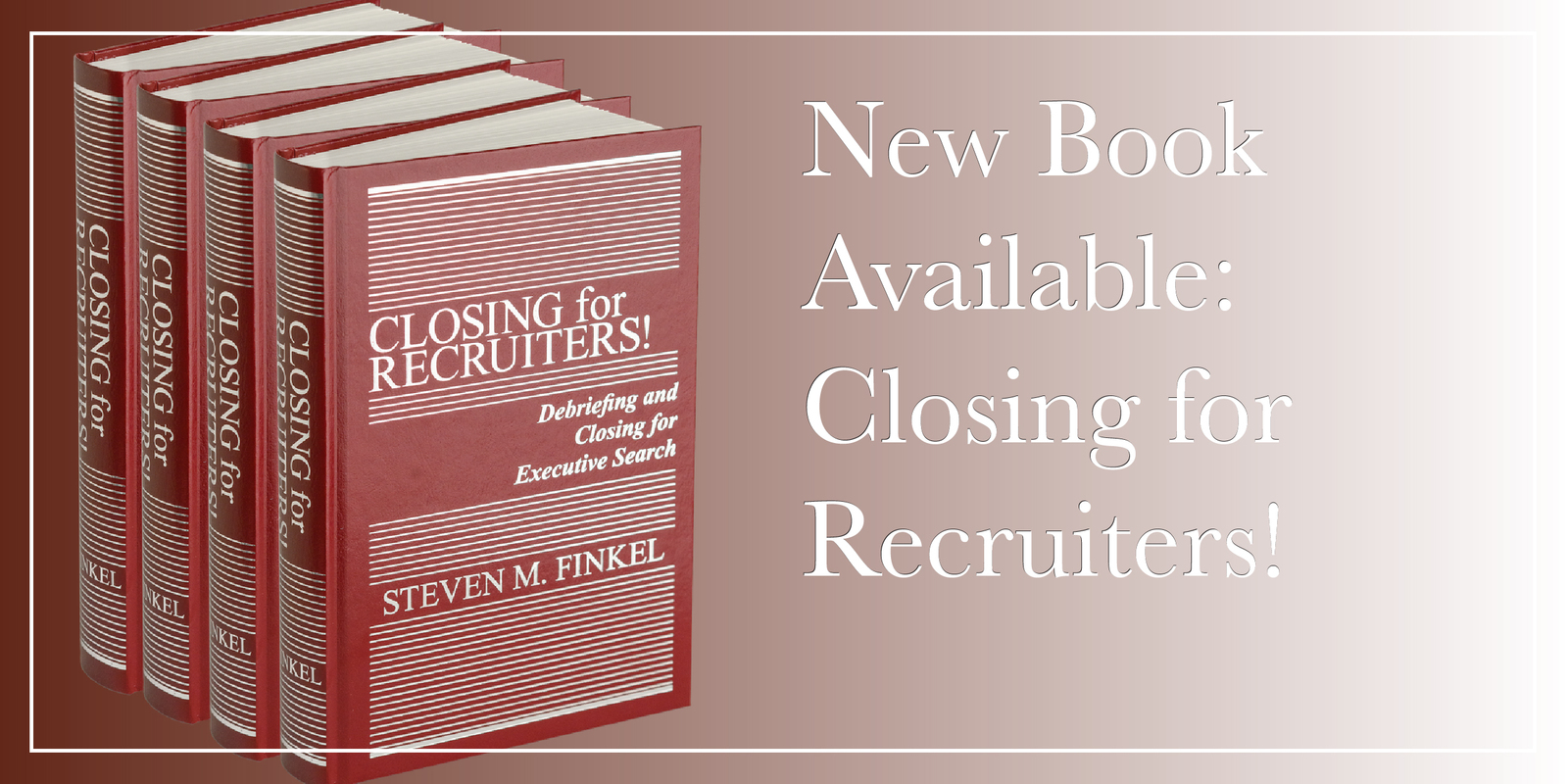
How complex is this? Consider that my brand-new book, Closing for Recruiters!, contains 300+ pages of material that has never been broadly offered to the industry. But only in this way – mastering these critical but overlooked portions of the search process – can we maximize our worth to the client. Moreover, it will insulate us from the techno-tools which clients may believe will enable them to avoid us. And it will dramatically increase your production.
Consider and act. You now have the opportunity to obtain many more offers – and to close the close ones!
Note: The book referenced above is available through https://www.stevefinkel.com/